Written by: Lan An
Edited by: Genevieve Hammang and Michelle Sosa
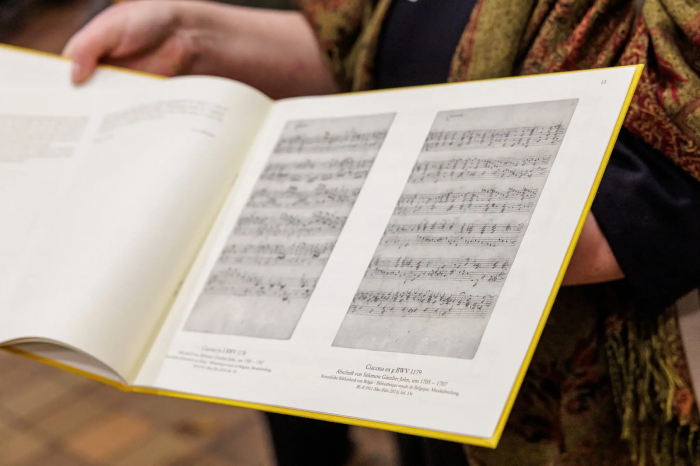
Ciacona in D Minor, BWV 1178, and Ciacona in G Minor, BWV 1179. Jens Schlueter/Agence France-Presse, via Bach Archive/AFP Via Getty Image, from the New York Times article.
Two previously unknown Bach pieces premiered at St. Thomas Church in Leipzig earlier last month. The works—Ciacona in D Minor, BWV 1178, and Ciacona in G Minor, BWV 1179—were composed by a teenage Johann Sebastian Bach during his early years as an organist in Arnstadt. They were identified by Leipzig-based scholar and Bach Archive director Peter Wollny, who discovered these unsigned manuscripts in the Royal Library of Belgium in 1992. Their recent attribution highlights not only a remarkable story of musicological sleuthing but also the enduring importance of special collections and digital research infrastructures.
The chaconnes belong to a formative period in Bach’s development. Beginning his post as an organ teacher in Arnstadt in 1703 at the age of 18, Bach synthesized the Central and North German musical traditions he learned earlier in Ohrdruf and Lüneburg. For over thirty years, Wollny revisited the mysterious manuscripts, gathering stylistic and paleographic clues. The decisive breakthrough came through the BACH Research Portal, a long-term digital-humanities initiative to map and digitize all archival sources on the Bach family. While surveying the Thuringian church archives, Wollny’s colleague Dr. Bernd Koska discovered a 1729 job application from an obscure organist, Salomon Günther John, who claimed to have been Bach’s pupil. Once Wollny located an earlier court document written by John, he compared the handwriting to that of the two anonymous chaconnes, confirming the identity of their scribe and dating the works to around 1705.
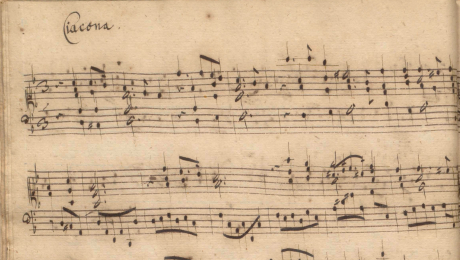
A detail from the first page of the Ciacona D minor BWV 1178, Bach Archive Leipzig.
This discovery exemplifies the mission of the Bach Archive Leipzig, the world’s leading research center on J. S. Bach, his family, and Central German music of the 17th and 18th centuries. Its special collections that encompass manuscripts, prints, letters, early copies, and biographical documents of the Bach family, form one of the most comprehensive repositories dedicated to a single composer. In partnership with the adjacent Bach Museum Leipzig, the Archive engages both Bach scholars and the general public.
A major part of the Bach Archive’s mission is its expanding suite of digital platforms. The most influential is Bach Digital, a research database jointly maintained with major German libraries and funded by the DFG. Built on the MyCoRe framework, it consolidates data on the works of Bach and his composing sons, linking musical works to sources, watermarks, scribes, and provenance. High-resolution scans virtually reunite manuscripts dispersed across global libraries, while the companion interface, Bach Digital smart, offers streamlined, mobile-friendly access.
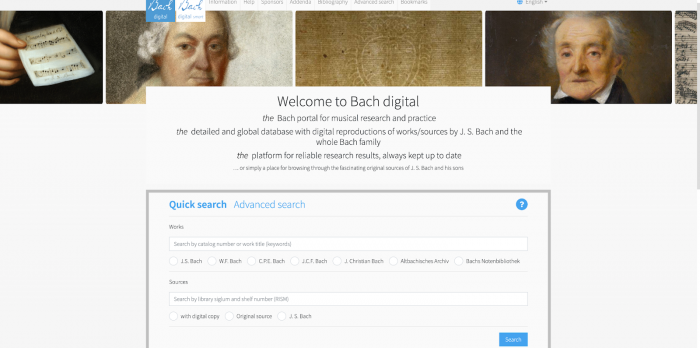
A screenshot of Bach Digital’s homepage. Version 2025.06 powered by MyCoRe.
The Archive also hosts the Bach Biographie Online, a multimedia timeline of Bach’s life. Integrating manuscript images, recorded Bach quotations, contextual commentary, performance videos from the J. S. Bach Foundation St. Gallen, and audio from Deutschlandfunk Kultur, the online biography illustrates how storytelling and digital curation can enhance public engagement.
Complementing these resources is the Bach Bibliography Online, an international database of roughly 79,000 scholarly items. Managed by the Bach Archive under the direction of Professor Yo Tomita, it brings together monographs, articles, reviews, musical editions, and digital publications on Bach.
For librarians and archivists, the Bach Archive demonstrates how traditional special collections and digital infrastructures can work together and form a dynamic ecosystem. Discoveries like the newly attributed chaconnes show that archives—both analog and digital—remain active spaces that have the power to continue to reshape cultural history.
0 Comments