Written by: Lan An
Edited by: Genevieve Hammang
Visitors to Carmel-by-the-Sea might be surprised to discover California’s first library at Mission San Carlos Borromeo de Carmelo, also known as the historic Carmel Mission. Housed within its walls is a collection that has endured since 1770, making it the oldest surviving library in the state.
Mission Carmel was the second of 21 missions established by Franciscan brothers and Spanish troops between 1769 and 1833. It was also the final resting place of Junípero Serra, the priest who founded eight of these missions. This history is, however, inseparable from the systematic subjugation of Indigenous people. “At Mission Carmel, near the native village of Tamo, Esselen and Ohlone Indians were forcibly relocated, baptized, enslaved, and punished,” according to the introduction to the art piece that depicts the mission at de Young Museum in San Francisco. These systematic abuses, along with the “epidemics of disease carried by the missionaries, caused Native populations to decline by more than thirty percent between 1769 and 1846.”
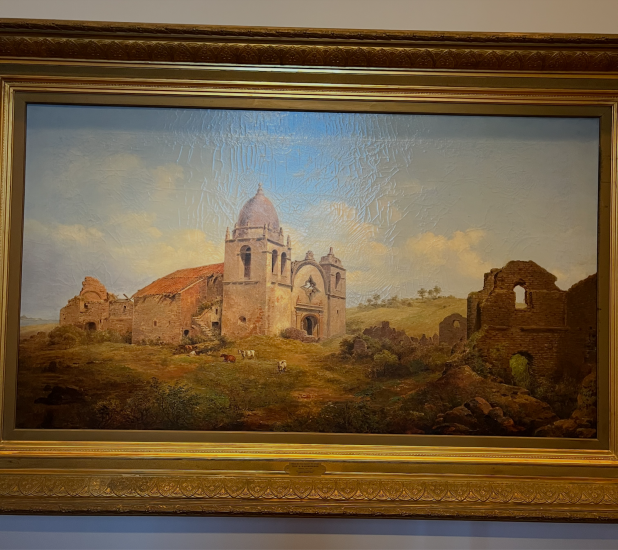
Mission San Carlos Borromeo Del Carmelo (1875) by Juan Buckingham Wandesforde at de Young Museum, San Francisco. Photographed by the author.
The missions served as religious outposts, self-sufficient economic centers, and, at times, information hubs. While Mission San Diego was founded first and once had a library, its collections were destroyed and rebuilt several times, vanishing almost entirely by 1852. This distinction makes the library at Mission Carmel California’s first permanent library.
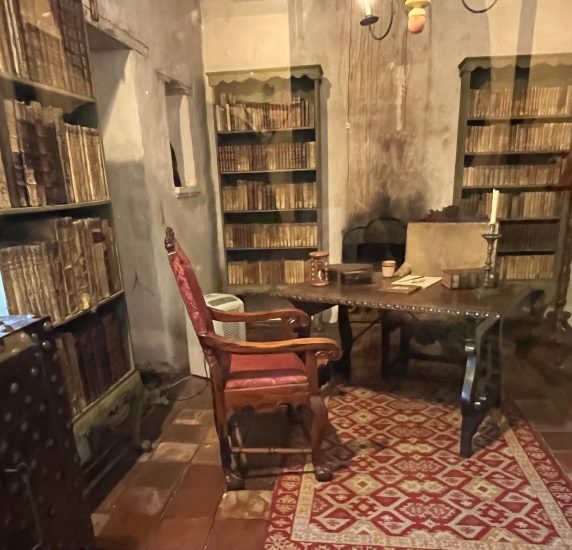
California’s first library at the Convento Museum of Carmel Mission. Photographed by the author.
Now part of the Convento Museum, the library once held books that provided indispensable theological guidance and practical advice for the mission’s daily operations. According to the mission, the collection was “compiled from among the handed-down and well-circulated volumes of Mexico City’s San Fernando Apostolic College, which administered the missions, its Mexican missions, and its originally Jesuit Lower California Missions.” Topics ranged from agriculture, architecture, and history to music and medicine.
The collection’s development is well-documented. By 1778, it consisted of around thirty books. By Serra’s death in 1784, it grew to fifty. The collection reached 302 volumes when it was first cataloged by Serra’s successor, Fermín de Lasuén. For library history enthusiasts, Lasuén’s cataloging system is particularly fascinating: each book was numbered at the top of its spine to indicate its bookcase number and shelf position. No further cataloging was done at Carmel after Lasuén’s death in 1803.
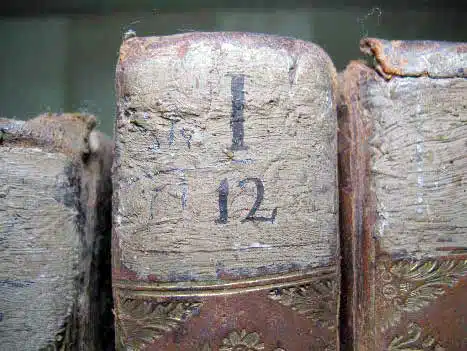
The books were catalogued on the upper section of the spine with black India ink. According to Geiger, “the highest numbers of the four sections into which the library was divided were I/79, II/119, III/113, and IV/84.” Photo courtesy of California’s First Library.
The mission’s 1834 secularization inventory listed 179 titles (totaling 404 individual books), which were dispersed after the mission’s abandonment in 1852. The majority of these volumes were stored in the parochial rectory in Monterey until 1949, when 229 of the original titles were returned.
Today, the library totals approximately 600 volumes. This number includes the returned original titles, as well as the personal collections of Monterey’s pastors from 1850 to 1930. The library room, arranged by mission restorer Harry Downie, is now a museum exhibit, and a copy of Serra’s Bible is also on display.
For library students and researchers, the collection itself is no longer accessible for direct handling. However, the Santa Barbara Mission Archive-Library holds an extensive collection of California Mission documents and early writings. The Archive-Library is open to researchers by appointment only and provides remote research assistance.
0 Comments