Written by Sophia Catalano, Blogging Coordinator
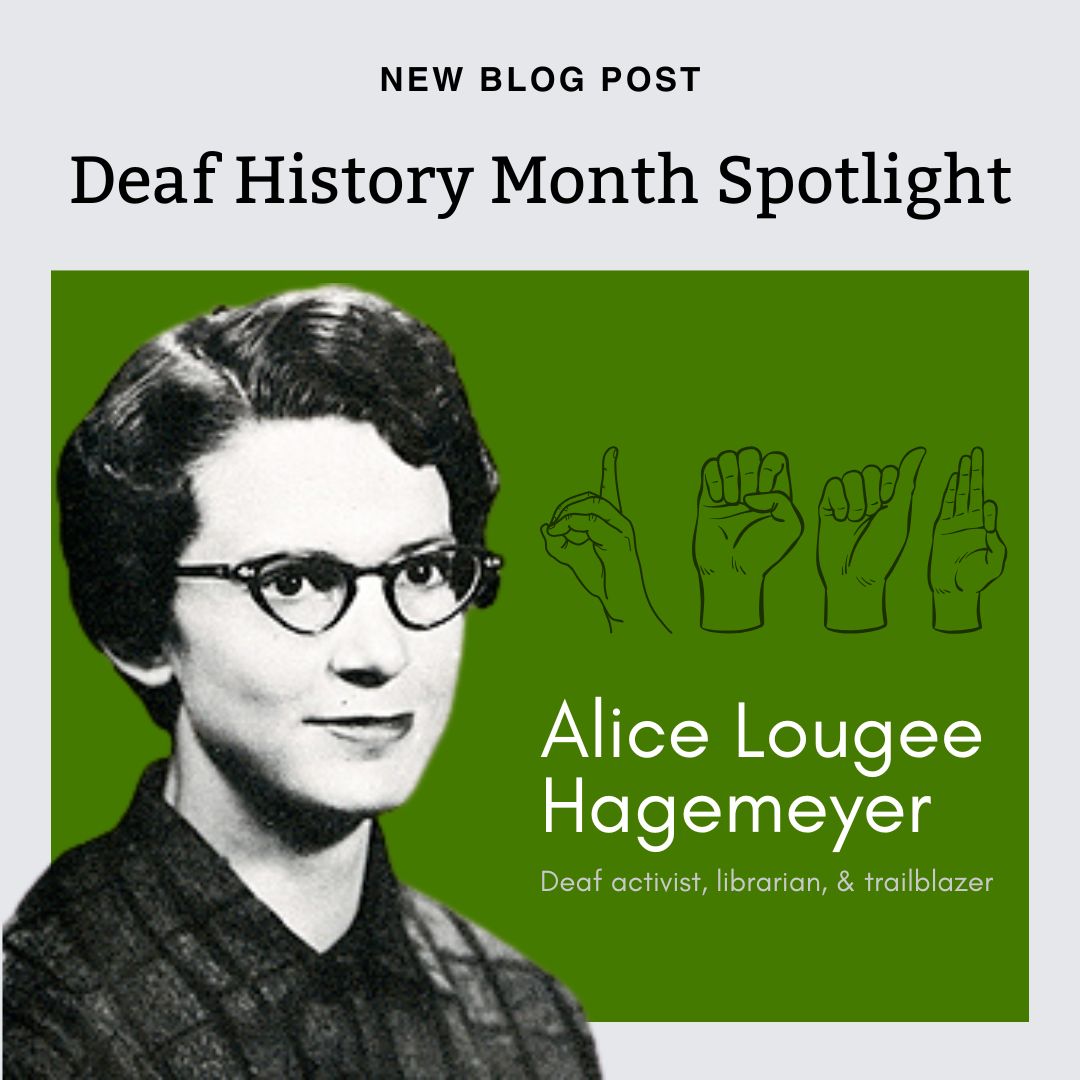
April is Deaf History Month and the SJSU ALASC would like to highlight a very special and important figure in the Deaf and library communities: Alice Lougee Hagemeyer. While not born deaf, Alice would go on to become an activist for the Deaf community, an advocate for deaf people in libraries, and a champion for federal funding to be granted for services for the deaf in public libraries.
Born on February 22, 1934 in Nebraska, Alice Lougee Hagemeyer was born hearing, but would become deaf at the age of 3 ½ after contracting spinal meningitis. At the age of 5 ½, Alice would be sent to Omaha to the Nebraska School of the Deaf, which did not teach American Sign Language and was strictly an oralist school, meaning they taught kids to speak and read lips. The use of sign language was forbidden. However, Alice would end up learning ASL from older students, as well as deaf adults who worked at the school.
In the book Great Deaf Americans by Matthew Moore, Alice reveals she did not visit a public library until her junior year of high school. One of her teachers knew she was interested in attending Gallaudet University* (a university in Washington, D.C. for those who are deaf and hard of hearing) gave her a list of books to read. Alice would end up attending Gallaudet, majoring in Library Science, and graduating in 1957. She worked at the DC Public Library (DCPL), first as a clerk, then a preliminary cataloger, before obtaining her Master’s in Information and Library Science from the University of Maryland in 1976.
Alice would go on to do many amazing things for the Deaf community in her time as a librarian. In December of 1974, she launched Deaf Awareness Week at the DCPL, which featured deaf speakers, and led to other libraries following suit. In 1978, after Alice had approached the board two years earlier, the ALA formally established the Library Services to the Deaf Forum. In 1986, Alice Lougee Hagemeyer would found FOLDA (Friends of Libraries for Deaf Action) with two goals in mind:
- Encourage better understanding by the library community and general public of the Deaf community
- Increase the Deaf community’s awareness of services available to them in public libraries
While at FOLDA, Alice wrote The Red Notebook, a “‘first-stop information’ resource that would provide unbiased information for all groups within the deaf community” that is now exclusively sold by the National Association of the Deaf (Moore, p. 290). She would also be the Delegate-at-Large for the 1st and 2nd White House Conferences on Library and Information Services in 1979 and 1991, respectively.
In her 1992 paper “We Have Come a Long Way,” Alice remarks that a lot of people tend to group deaf and blind people together and that comparison simply isn’t true. She notes that, “However, it is a fact that blind people are kept away from things while deaf people are separated from other people.” (Hagemeyer, p. 5) She states that while blind people are at a disadvantage, they are still able to communicate with people and hear people communicate with them. They had (at the time of her writing this paper) federal funding for library services while deaf people had none, and were able to receive accommodations more easily than deaf people. This paper is a very informative one, and I would highly recommend anyone interested should read it. It will be linked down at the end of this post.
It cannot be stated enough how much of a trailblazer Alice Lougee Hagemeyer was and is in the library community. She has done so much for the Deaf community and continues to do so. In 2007, she was given the ALA’s highest honor of Honorary Membership at the annual conference. She is still working today as a library consultant and a deaf activist.
*Gallaudet University was named after Thomas Gallaudet, who along with Laurent Clerc, are considered the founders of American Sign Language. After Gallaudet traveled to Europe and learned French Sign Language, Gallaudet and Clerc sailed back to Connecticut and opened a school for the deaf in Hartford, known as the American School for the Deaf. It is important to note that American Sign Language evolved out of French Sign Language, signs already being used by deaf Americans, and home signs used by individual families. Sign Language is like any other language in that it has accents and different people sign in different ways. If you really want to go down a rabbit hole, try researching Martha’s Vineyard Sign Language.
Citations:
Hagemeyer, A. L. (1992). We have come a long way. Library Trends, 41(1), 4-20. https://www.ideals.illinois.edu/items/7773
Moore, M. S., & Panara, R. (1996). Great deaf Americans: The second edition. Deaf Life Press.
https://openlibrary.org/works/OL3278095W/Great_deaf_Americans?edition=key%3A/books/OL986494M
Further Resources and Readings:
https://www.ala.org/accessibility/deaf-or-hard-hearing
https://www.nidcd.nih.gov/directory/friends-libraries-deaf-action-folda ‘
https://accessibe.com/glossary/deaf-vs-deaf
___________________________________________________________________________________________
My name is Sophia Catalano, and I am your new Blogging Coordinator for the SJSU ALASC. I love to learn new things, and that includes languages (I took ASL for three years in high school, and have continued learning it on my own in the years since then). I have two dogs named Ajax and Athena (can you tell I’m a history nerd?), my favorite color is green, and a fun fact about me is that I make zines.