 Events
Migration Is Beautiful: The Mujeres Latinas Project
The SAASC joined up with Reforma to host a discussion with the Assistant Curator at the Iowa Women’s Archive (IWA).
The IWA was founded in 1992 by Louise Noun and Mary Louise Smith who pitched the idea. Louise Noun just happened to be an art collector and had Frieda Kahlo’s Self-Portrait with Loose Hair in her home. The painting sold for $1.5 million and the proceeds helped start the Iowa Women’s Archive.
In 2005, Nancy “Rusty” Barceló wanted to preserve the papers of Iowa Latinas and suggested the IWA create the Mujeres Latinas Project. The Mujeres Latinas Project is a collection comprised of photographs, reports, and memoirs. The archive chronicles the lives of Iowa Latinas, their families, and their organizations. The importance of the archive is that it can reframe our understanding of history and help tell the stories of marginalized women whose stories, at one time, were not considered worthy of remembering.
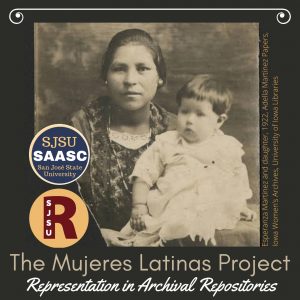
The archive began as an oral history project with interviews conducted to document their stories. Over time, the project grew to include written documents and other items that were donated to the collection. The collection tells the story of migration from Mexico to the mid-west of the United States to eventual settlement in Iowa.
From the Mujeres Latinas Project came ‘Migration is Beautiful’ which highlights the contributions of Latinx to Iowa history. Migration is central to understanding and interpreting the past, shaped first by Native Americans, and later by immigrants from around the world.
I will leave you with these words from Janet Weaver:
“I talked a lot about history, but I think that’s the power of archives, is it not? That we have the capacity to bring in the documents and build an inclusive archival repository that we can make the understanding and interpretation of history more inclusive. And make sure everybody, like Micaela Terronez, can find themselves in the archives.”
The SAASC and Reforma would like to thank Janet Weaver and the Iowa Women’s Archive for presenting this informative discussion. Missed the live event? No worries! You can view this event on the SAASC’s YouTube channel here. Be sure to check out our other amazing events!
**Want to write a blog post for the SAASC or have an interesting idea for a blog post? Let us know! Email us at sjsusaasc@gmail.com. Like the events the SAASC organizes? Consider joining the SAASC at SJSU! You can join here. **
 Rick has continued to add new films to the online collection, and when a friend forwarded me his call for volunteer film scanners, I replied immediately. A big perk of this volunteer gig was learning to use the lasergraphics motion picture scanner, which is capable of producing very high-resolution digital files, much better quality than I ever saw when I was working as an editor. The device is something like a projector connected to a computer controller, and I felt like I had one foot in the past world of celluloid and the other in the current digital technology, first threading the film onto the scanner, then turning to the computer to create the scan.
 The second perk of scanning these films was watching them; scanning takes place in real-time, and once I hit “run job,” there was nothing to do but watch. I saw films on Argentinean ranches, the workings of an orchestra, on etiquette, teen marriage, and how to walk safely to school. My favorite during my volunteering stint was “Healthy Teeth, Happy Smile” a dental hygiene film from 1964. Hygiene films of all kinds are quite common, but what made this one interesting to me was that it featured an integrated cast, led by an African-American protagonist. Since most educational films of the 1950s and early 60s tend to depict an almost entirely white, middle-class world, this one stood out—and the giant set of teeth the heroine scrubs with a giant toothbrush was pretty memorable too.